


Overname van een handelszaak:
15 knelpunten onder de loep
Mr. Vanessa Ramon en mr. Mariël Van Vynckt (Cygnus Advocaten)
Webinar op donderdag 18 maart 2027
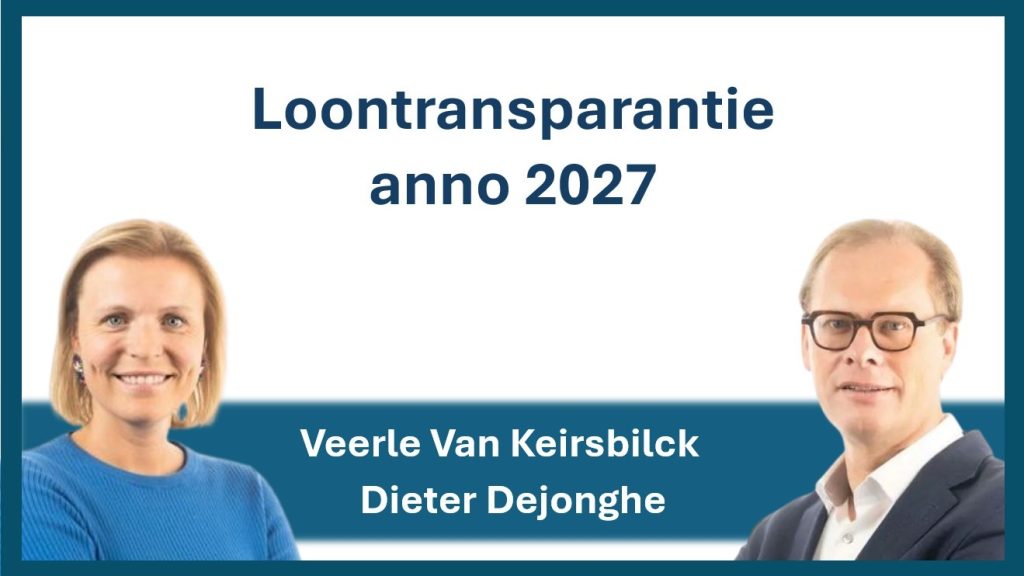
Loontransparantie anno 2027
Mr. Dieter Dejonghe en mr. Veerle Van Keirsbilck
(Claeys & Engels)
Webinar op donderdag 18 februari 2027

Ontslag van A tot Z anno 2027
Mr. Kato Aerts, mr. Katrien Coenen
en mr. Sarah Witvrouw (Lydian)
Webinar op donderdag 25 februari 2027

Wenst u meerdere opleidingen
te volgen bij LegalLearning?
Overweeg dan zeker onze voordeelformules!
Krijg toegang tot +250 opleidingen
Live & on demand webinars
Met tussenkomst van de kmo-portefeuille

Bonusbeleid anno 2027.
Warrants en CAO nr. 90 onder de juridische loep
Mr. Mieke Deconinck en mr. Jan Lein (Claeys & Engels)
Webinar op vrijdag 29 januari 2027

Tewerkstelling van buitenlandse
werknemers anno 2026
Mr. Sophie Maes en mr. Simon Albers (Claeys & Engels)
Webinar op vrijdag 23 oktober 2026
Government reveals “Jobsdeal” (Loyens & Loeff)
Author: Ellen Herinckx and Hélène Deroubaix (Loyens & Loeff)
Date of publication: 26/07/2018
#JobsJobsJobs, so is the title of the presentation given by Prime Minister Michel on Tuesday 24 July – and for good reason: no less than 28 new employment measures have been announced, together comprising the so-called “Jobsdeal”.
This deal aims to reform the labour market and will have a considerable impact on both employers and employees in Belgium. Below you will find the main features of this reform as disclosed by the government up to today.
Reform unemployment with company allowance
The current system of unemployment with company allowance (“SWT”/”RCC”) will become less accessible. Employees willing to benefit from the general system (accessible from 62 years old) will be required to have worked for a period of 41 years instead of 40 years. This period will remain lower for female employees.
Besides, for employees in companies in restructuring, the minimum age to benefit from the system will be increased to 59 years old as from 2019 and to 60 years old as from 2020.
Mobility budget
The government has approved the mobility budget together with a reform of the system for “cash for car”.
The reform is said to be aimed at simplification, but further details are yet to be disclosed. This is, however, a first step towards more flexibility.
Reform unemployment allowances
A third big measure targets the system of gradual reduction of the unemployment allowances. Currently, unemployed persons are entitled during the first six months of unemployment to 65% of their last salary, capped at 2.619 EUR. The government decided to raise the amount of the allowances during the first six months, while substantially reducing it afterwards.
Unemployed persons who are following a training or an internship for a bottleneck vacancy, however, will be rewarded and remain exempt from the new reduction.
The shift as such will be strictly budget-neutral, but regional employment services will receive new competences to stimulate unemployed persons during this first period of six months.
Activation of unemployed persons
The government announced different measures which will be aimed at the activation of unemployed persons, among which the most important are:
- an outplacement premium up to 1800 EUR awarded to employees who are going back to work after dismissal for medical force majeure;
- capped tax exemptions for several new premiums for unemployed persons following a training for a bottleneck vacancy that leads to a return to work;
- entitlement to end-of-career time credit (“tijdskrediet”/”credit-temps”) becoming more difficult, with the age requirement increasing to 60 years by 1 January 2019 instead of 59 years currently;
- thematic time credit for continuous training for bottleneck vacancies increasing to a period of 48 months instead of 36 months.
With the measures composing the Jobsdeal, a clear focus is set on combating skills shortages and the return of workers to the labour market.
The necessary legislative and regulatory acts still need to be adopted. The reform is nevertheless scheduled to be applicable as of January 2019.
» Bekijk alle artikels: Arbeid & Sociale zekerheid




Boeken in de kijker: