

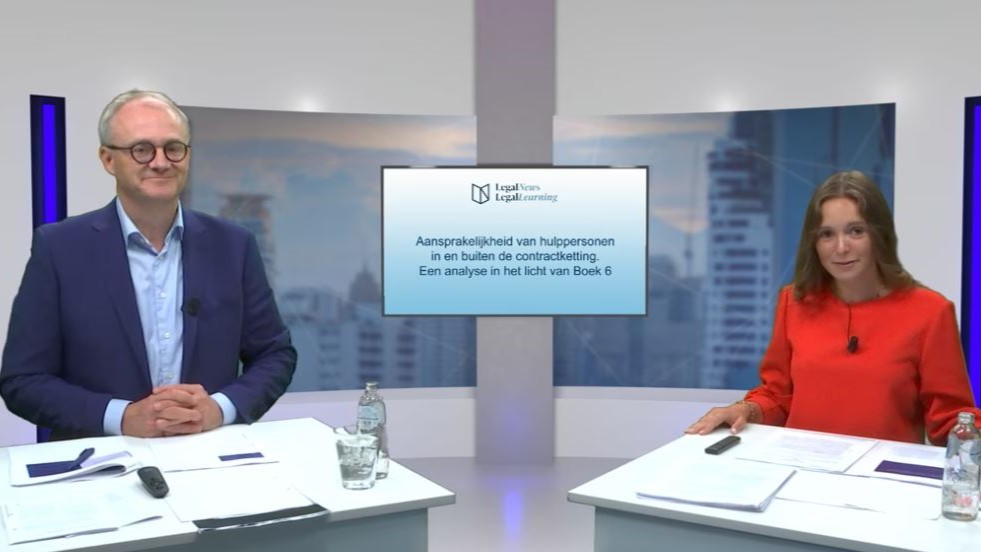
Aansprakelijkheid van medische beroepsbeoefenaars en zorginstellingen anno 2027
Prof. dr. Christophe Lemmens (Dewallens & partners)
Webinar op vrijdag 15 oktober 2027

Koop-verkoop van onroerend goed:
obstakels uit de praktijk
Mr. Jérémy Vanderheyde en mr. Karel Veuchelen
(Scale / Schoups)
Webinar op donderdag 19 november 2026

Aansprakelijkheid voor gebrekkige producten:
de uitbreiding van Boek 6 BW
(inclusief handboek)
Dhr. Constant De Koninck (Rekenhof)
Webinar op donderdag 20 mei 2027

Overname van een handelszaak:
15 knelpunten onder de loep
Mr. Vanessa Ramon en mr. Mariël Van Vynckt (Cygnus Advocaten)
Webinar op donderdag 18 maart 2027

Zekerheden anno 2026:
een update aan de hand van wetgeving en rechtspraak
Mr. Ivan Peeters (NautaDutilh)
Mr. Philip Van Steenwinkel (Hogan Lovells)
Webinar op donderdag 19 november 2026

Omgevingsprocedure:
de allerlaatste ontwikkelingen
Mr. Bart De Becker (De Becker Advocaten)
Webinar op donderdag 26 november 2026
Forget hardship clauses, here come “hell or high water” clauses (LegalNews.be)
Author: LegalNews.be
Date of publication: 23/07/2018
Olivier Vanden Berghe (Partner Contracts & Litigation at Liedekerke Wolters Waelbroeck Kirkpatrick) gives more explanation.
The main novelty in the future Belgian Civil Code, presently still a draft, is the introduction of hardship (“imprévision”) in contract law. In case of unforeseeable changed circumstances that render the performance of the agreement so excessively onerous that it cannot be reasonably expected from a party, said party is entitled to ask the other party for a renegotiation or termination of the contract. If no agreement is found between the parties, the court may, in an expedite procedure, adapt or terminate the agreement (or not). Until then, the initial terms of the contract should be respected.
This hardship regime however will not be of mandatory law. One can therefore expect a significant increase of clauses providing that each party (or as a matter of fact only one party) must perform “come hell or high water”, meaning no matter what happens and in spite of all difficulties, whether foreseeable or not.
I wonder how courts will react to those assumption of risk or “hell or high water” clauses. Even if in theory such agreed clauses could still be set aside because of abuse of right, this should in my opinion be quite exceptional.
» Bekijk alle artikels: Verbintenissen & Goederen, Verzekeringen & Aansprakelijkheid



Boeken in de kijker: