

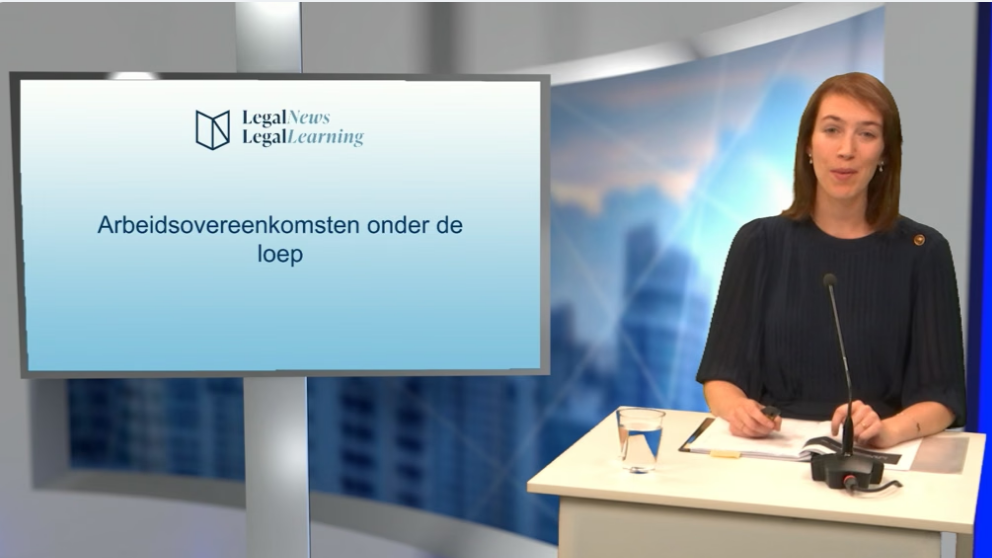
Ontslag van A tot Z anno 2027
Mr. Kato Aerts, mr. Katrien Coenen
en mr. Sarah Witvrouw (Lydian)
Webinar op donderdag 25 februari 2027

Overname van een handelszaak:
15 knelpunten onder de loep
Mr. Vanessa Ramon en mr. Mariël Van Vynckt (Cygnus Advocaten)
Webinar op donderdag 18 maart 2027

Tewerkstelling van buitenlandse
werknemers anno 2026
Mr. Sophie Maes en mr. Simon Albers (Claeys & Engels)
Webinar op vrijdag 23 oktober 2026

Bonusbeleid anno 2027.
Warrants en CAO nr. 90 onder de juridische loep
Mr. Mieke Deconinck en mr. Jan Lein (Claeys & Engels)
Webinar op vrijdag 29 januari 2027

Loontransparantie anno 2027
Mr. Dieter Dejonghe en mr. Veerle Van Keirsbilck
(Claeys & Engels)
Webinar op donderdag 18 februari 2027

Grensoverschrijdende sociale zekerheid
anno 2026: een update
Dhr. Bruno De Pauw (RSZ)
Webinar op vrijdag 20 november 2026
Court of Justice condemns Belgian system for disregarding the A1 Declaration (Loyens & Loeff)
Author: Ellen Herinckx (Loyens & Loeff)
Date of publication: 11/07/2018
On 11 July 2018, the Court of Justice issued an important ruling in the case C-356/15 European Commission versus Belgium.
The Court of Justice ruled that Belgian legislation, which provides that Belgian authorities can unilaterally declare posted workers subject to the Belgian social security legislation, is inconsistent with EU legislation.
A1 Declaration is presumed to be binding
An A1 Declaration is an official document issued by a Member State in which a company that is posting workers is established. It constitutes a presumption that the posted workers are regularly affiliated to the social security scheme of that Member State. In principle, the Member State in which those workers are being posted is bound by such declaration.
In 2013, the Commission initiated an infringement procedure against Belgium because of the programme law of 27 December 2012. This legislation allows the Belgian competent authorities to decide unilaterally, without following the dialogue and reconciliation procedure included in EU legislation, that A1 Declarations of posted workers can constitute an abuse of rights.
Dialogue- and reconciliation procedure
Referring to its recent Altun case-law, the Court of Justice emphasised that Member states should always follow a specific dialogue- and reconciliation procedure in case of doubts about the A1 declaration.
- First, the competent authorities of the Member state of origin is obliged to properly asses and re-evaluate the facts underlying the A1 declarations they have issued;
- If doubts remain, the case should be brought before the administrative commission of the European Union (https://socialsecurity.belgium.be/nl/internationaal-actief/administratieve-commissie-voor-de-coordinatie-van-de-socialezekerheidssystemen);
- Should this commission fail to reconcile the views, a specific procedure of ‘non-compliance’ has to be initiated;
- Only if the Member State of origin does not re-evaluate the situation within a reasonable period of time, Belgian authorities are allowed to set aside the A1 declaration on the basis of national legislation.
Belgian arguments are insufficient
According to Belgium, the prohibition of abuse of rights is a general principle of law which allows Member States to derogate from EU law, including the dialogue- and reconciliation procedure. The Court of Justice, however, decided that the unilateral decision process of Belgium is inconsistent with EU legislation (EU Regulation No 883/2004 and EU Regulation No 987/ 2009). In the future, even in case of obscure A1 Declarations, it will be more complicated to set aside its binding nature.
» Bekijk alle artikels: Arbeid & Sociale zekerheid




Boeken in de kijker: