

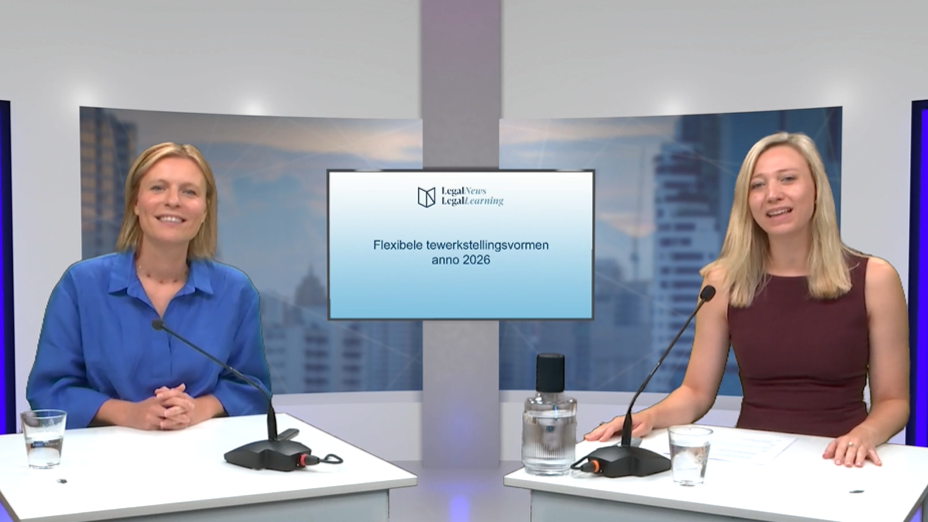
Tewerkstelling van buitenlandse
werknemers anno 2026
Mr. Sophie Maes en mr. Simon Albers (Claeys & Engels)
Webinar op vrijdag 23 oktober 2026

Grensoverschrijdende sociale zekerheid
anno 2026: een update
Dhr. Bruno De Pauw (RSZ)
Webinar op vrijdag 20 november 2026

Wenst u meerdere opleidingen
te volgen bij LegalLearning?
Overweeg dan zeker onze voordeelformules!
Krijg toegang tot +250 opleidingen
Live & on demand webinars
Met tussenkomst van de kmo-portefeuille

Bonusbeleid anno 2027.
Warrants en CAO nr. 90 onder de juridische loep
Mr. Mieke Deconinck en mr. Jan Lein (Claeys & Engels)
Webinar op vrijdag 29 januari 2027

Overname van een handelszaak:
15 knelpunten onder de loep
Mr. Vanessa Ramon en mr. Mariël Van Vynckt (Cygnus Advocaten)
Webinar op donderdag 18 maart 2027

Ontslag van A tot Z anno 2027
Mr. Kato Aerts, mr. Katrien Coenen
en mr. Sarah Witvrouw (Lydian)
Webinar op donderdag 25 februari 2027
Career credits (K law)
Authors: Alexis Ceuterick and Laura Declercq (K law)
Date of publication: 28/02/2018
As the social partners were not able to reach an agreement on an alternative framework, the legal rules provided in the law on workable and maneuverable work of 5 March 2017 (Law-Peeters) related to career credits came into force on 1 February 2018.
The career credits system is a new concept that offers employees the opportunity to save “time”. Concretely, employees will be able to exchange saved time/credits into leave, later in their careers. There is no obligation for an employer to establish a career credits plan for their employees nor is there any obligation for an employee to take part in such a program.
According to the law, the following time-elements can be saved:
- the new credit for voluntary overtime that must not be compensated by granting additional rest;
- the complementary vacation days that are granted by a collective labor agreement;
- when using a flexible schedule, the hours worked above the average weekly working hours can be transferred at the end of the reference period;
- overtime performed in the context of an unforeseen necessity or an extraordinary increase in workload and which, at the discretion of the employee, may or may not be compensated by granting additional rest.
At a later stage, a Royal Decree can be issued that allows an employee, in addition to the four time elements mentioned above, to convert monetary premiums (e.g. the end-of-year bonus) into additional time off.
Implementation
Employees can only take advantage of such a system if a collective bargaining agreement (CLA) has been reached. The industry has 6 months (as from 1 February 2018) to provide such a framework. If the industry does not conclude a CLA, after this period of time companies can work out a company level CLA.
The following elements must be included in the CLA:
- the time periods that can be saved;
- the period in which the relevant time elements can be saved;
- the manner in which the employee can take the saved time/credits;
- the valuation that will be applied when the saved time/credits is taken (or paid out);
- the way in which the career credits and the guarantees for the employees are managed;
- the fate of the credits should the company go bankrupt.
The framework of the industry level CLA must also address how the acquired savings/credits should be transferred (within the sector) if the employee should leave the company.
End of employment
The employee is entitled to the full payment of their saved time at the moment that the employment ends.
This right to payment is also maintained if the industry level CLA provides the possibility to transfer the savings/credits in the event of a change of employer (within the same sector).
» Bekijk alle artikels: Arbeid & Sociale zekerheid



Boeken in de kijker: